 AI Bio 소식
 제품 검색
제품 검색 견적요청
견적요청 구매요청
구매요청 바이오엔터테인먼트
 논문
논문 나눔/중고거래
AI Bio 소식
[공식 대리점] Pronetbio-Yeast Three-Hybrid (Nuclear System) Vector Kit,효모 삼중 하이브리드 (핵 시스템) 벡터 키트(RY8011)
- AI바이오허브 오래 전 2025.01.29 00:19 Bulletin Board 인기
-
 656
656
 0
0

Yeast Three-Hybrid (Nuclear System) Vector Kit
- duct Description
Product Overview
The Yeast Three-Hybrid (Nuclear System) Vector Kit (CAT: RY8011) is designed to facilitate protein-protein-small molecule and protein-DNA/RNA interaction studies with precision. Building on the Yeast Two-Hybrid (Y2H) system, this kit introduces the innovative pBridge plasmid, allowing simultaneous insertion and expression of two foreign proteins under methionine-deficient conditions.
Key features include:
- Dual cloning sites (MCSI and MCSII) for inserting two proteins.
- Precise gene regulation via the MET promoter, active only in methionine-deficient media.
- Full compatibility with pGADT7 vectors for introducing additional genes of interest.
This kit is ideal for research applications such as transcription factor studies, nucleic acid-binding protein analysis, and drug discovery.
Kit Components
Component
Name
Concentration
Specification
Quantity
Plasmid
pGADT7
100 ng/µl
20 µl
1 tube
pBridge
100 ng/µl
20 µl
1 tube
Strain
Y187
Inoculated plate
90 mm plate
1 plate
Y2HGold
Inoculated plate
90 mm plate
1 plate
Primer
AD-R
Lyophilized
2 OD
1 tube
T7-F
Lyophilized
2 OD
1 tube
pBridge-1-F
Lyophilized
2 OD
1 tube
pBridge-1-R
Lyophilized
2 OD
1 tube
pBridge-2-F
Lyophilized
2 OD
1 tube
pBridge-2-R
Lyophilized
2 OD
1 tube
Key Features
Advanced pBridge Plasmid Technology
Dual protein expression under methionine-deficient conditions.
Flexible cloning sites with optimized primer sets for amplification and sequencing.
Comprehensive Compatibility
Fully compatible with pGADT7 vectors and yeast strains like Y2HGold and Y187.
Robust Performance
Achieve reliable and reproducible results for complex interaction studies.
Detailed Protocols and Support
Includes experimental guidelines and troubleshooting tips to ensure success.
Applications
Protein-Protein-Small Molecule Interactions: Explore how small molecules modulate protein complexes.
Transcription Factor Studies: Investigate DNA-binding proteins and regulatory mechanisms.
RNA-Binding Protein Research: Uncover novel RNA-protein binding partners.
Drug Discovery: Screen for compounds targeting multi-protein complexes or regulatory pathways.
Storage and Shipping Conditions
Material
Storage
Shipping
Plasmids
-20°C
Room temperature
Strains
Room temperature
Room temperature
Primers
-20°C
Room temperature
Experimental Guidelines
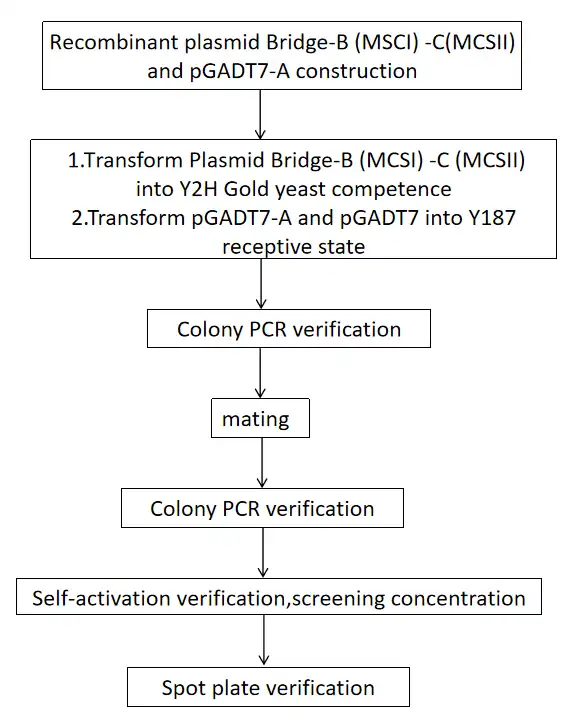
1. To ensure strain viability, streak the strain onto a YPDA agar plate before liquid culturing.
2. Store strains at -80°C with 50% glycerol to prevent repeated freeze-thaw cycles.
3. This product is for research use only and not for clinical, diagnostic, or therapeutic applications.
4. Maintain sterile conditions to avoid contamination.
Self-Prepared Materials
1. Sterile PCR tubes, tips, centrifuge tubes, shakers, incubators, and reagents like 50% PEG3350, 1M LiAc, X-α-Gal, and 3-AT.
2. (Optional from Pronetbio) Yeast media (YPDA, SD-Trp, SD-Trp/-Leu/-His), yeast plasmid extraction kits, and positive clone amplification kits.
FAQs
1. What is the difference between X-α-gal and X-gal?
X-gal is a substrate for β-galactosidase (LacZ), producing a blue product, while X-α-gal is specific for α-galactosidase (MEL1), used in yeast screening systems.2. Why is 3-AT used in the screening process?
3-AT is a competitive inhibitor of histidine biosynthesis, suppressing HIS3 background expression and reducing false positives.3. How do I preserve yeast strains after receipt?
Streak onto YPDA agar, isolate single colonies, and grow in liquid YPDA medium. Add sterile glycerol to 50% for long-term storage at -80°C.
